
Landscape Photography for Mental Health: Finding Calm in Storms
When depression and anxiety widen into something bottomless, they stop being just mental experiences. They become physical pressure: something that sits in the chest, tightens the muscles, and makes it difficult to find a way through the day.
In my darkest years, before my AuDHD (Autism/ADHD) diagnosis and before recovery began, I struggled to process emotions that felt too large for me to contain. Today, things are a little different, but overwhelming and negative feelings have not disappeared completely. I’ve found that landscape photography, particularly in the wild weather of the South Pennines, gives me a practical way to meet them.
For me, being exposed to the elements and photographing a storm is more than just creating a dramatic image. It’s about reconnecting with my body, giving my attention something tangible to work with, and discovering that I can experience the force of a storm without being consumed by it.
This is my experience of using landscape photography to navigate difficult emotions, living with AuDHD, and finding moments of catharsis in the outdoors. It’s not a prescription for mental health difficulties, but an account of something that has become important in my journey.
For a deeper look into my background, you can read my story by clicking here
When Emotional Pain Becomes Physical: AuDHD and Mental Health
Before I understood my neurodivergence, I had few explanations for the intensity of what I experienced. Depression, anxiety, and the constant effort of trying to navigate a world that often felt overwhelming left me carrying more than I knew how to process.
I turned to self-harm.
It never felt dramatic to me. It felt intensely practical: an attempt to take invisible, unbearable emotional pain and make it tangible. I was trying to regulate something I didn’t understand, to find an outlet for pressure that seemed to have nowhere else to go.
I share this because conversations about mental health recovery can sometimes make the journey sound tidier than it really is. It’s tempting to describe a difficult period as something that happened in the past, followed by a clean break into a happier future.
My experience has been more complicated. Recovery and education have changed my life, and the urge to escape myself is no longer the driving force behind my days. Life still overwhelms me. Stress accumulates, frustration builds, and I need to work through emotions that feel bigger than the situation in front of me.
The difference is, I’ve developed other ways of responding.
Understanding my AuDHD has helped me make sense of some of my experiences, although it doesn’t explain everything, nor does it affect everyone in the same way. Landscape photography has become one of the primary tools I use to navigate that emotional complexity.
I’ve learnt I do not always need to sit quietly and wait for negative feelings to pass. Sometimes, I need to move, engage my senses, and find an activity that gives my attention somewhere to go.
That discovery has led me back, repeatedly, to the South Pennines.
Why I Turn to Storm Photography in the South Pennines
There’s a particular intensity in standing on an exposed moorland when the weather’s changing. The wind presses against your clothing. Rain, snow, and hail sting your cheeks. The sound of the landscape changes as gusts roar across the open ground.
Something pulls your attention away from whatever’s been circling inside your head and directs it towards the immediate experience of being there.
For me, this form of storm photography can be deeply cathartic.
When the weather’s angry, I become acutely aware of my physical presence. I feel the pressure of the wind against my chest, notice the ground beneath my feet, and concentrate on staying comfortable, oriented, and balanced. The landscape demands attention without asking me to explain what I’m feeling.
I don’t need to find the right words for frustration or anxiety. I can simply notice what’s happening around me.
That distinction matters. I’m not trying to punish myself with hard conditions, nor am I suggesting that anybody should seek dangerous weather to manage emotional distress. What I value is the sense of physical immediacy that an appropriate outdoor experience can provide.
A quiet walk through the woodland may be exactly what somebody else needs. For me, sometimes the movement and intensity of wild weather feel more engaging than stillness. The important part is finding an experience that helps, rather than overwhelming you further.
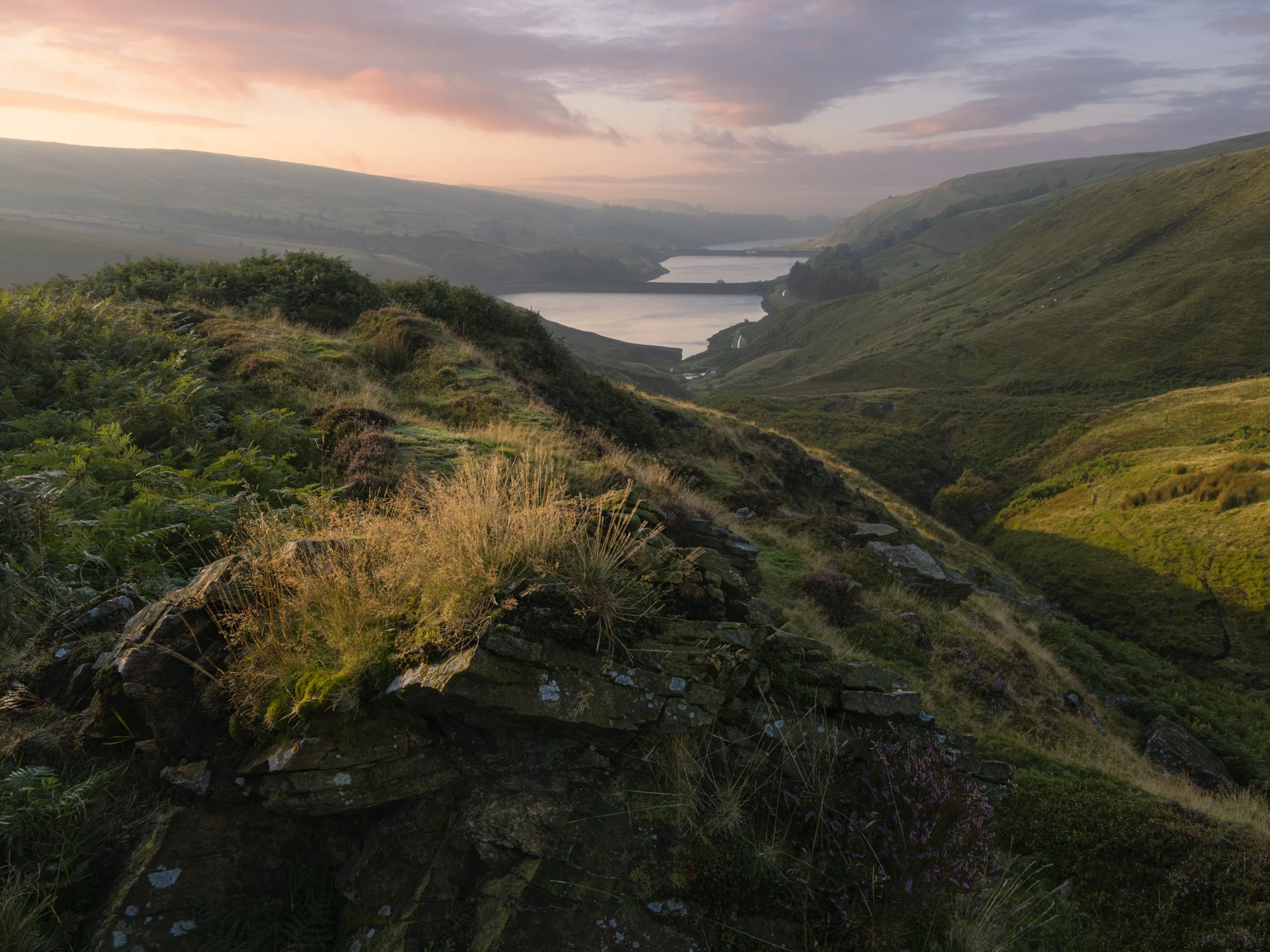
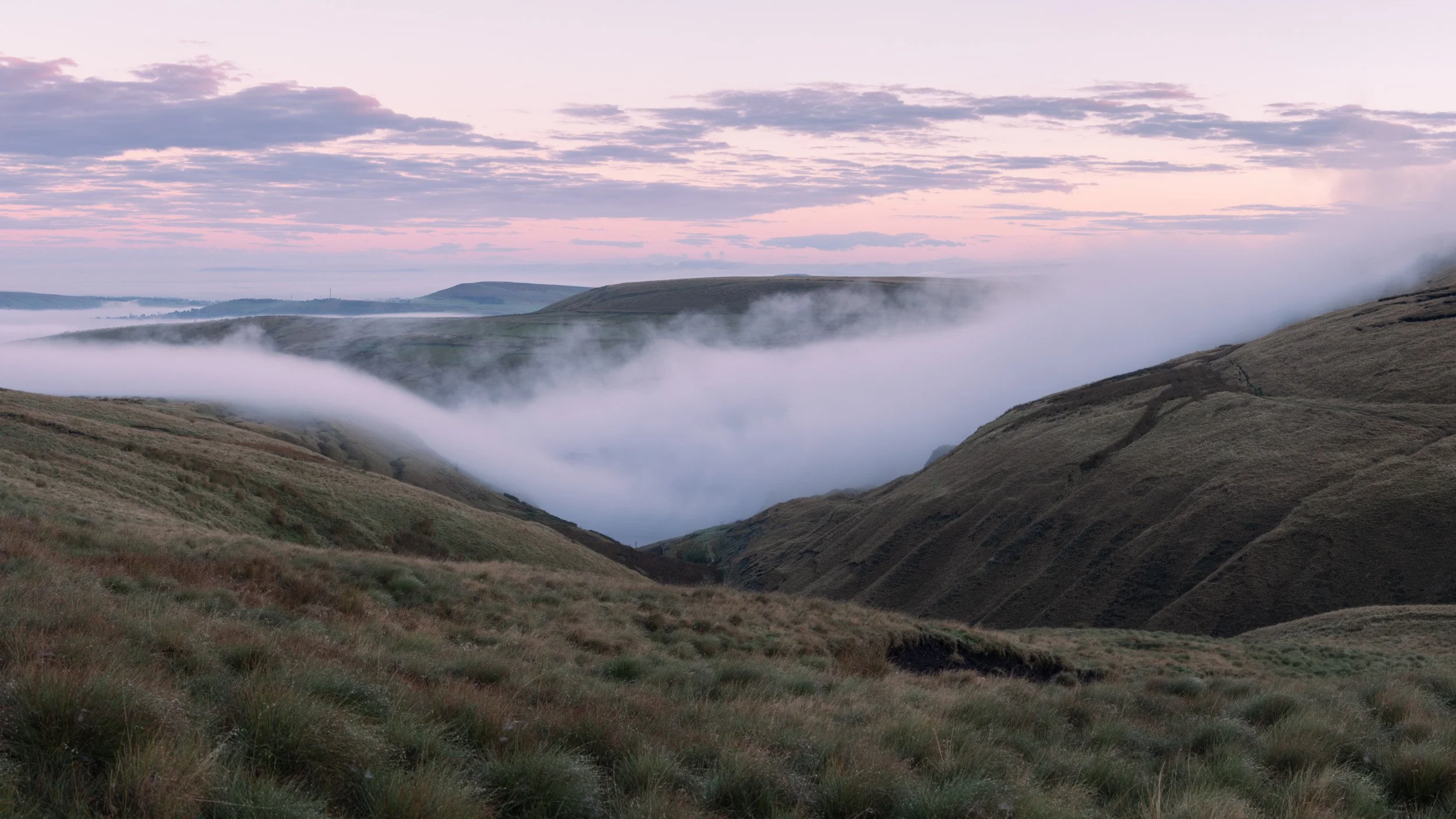
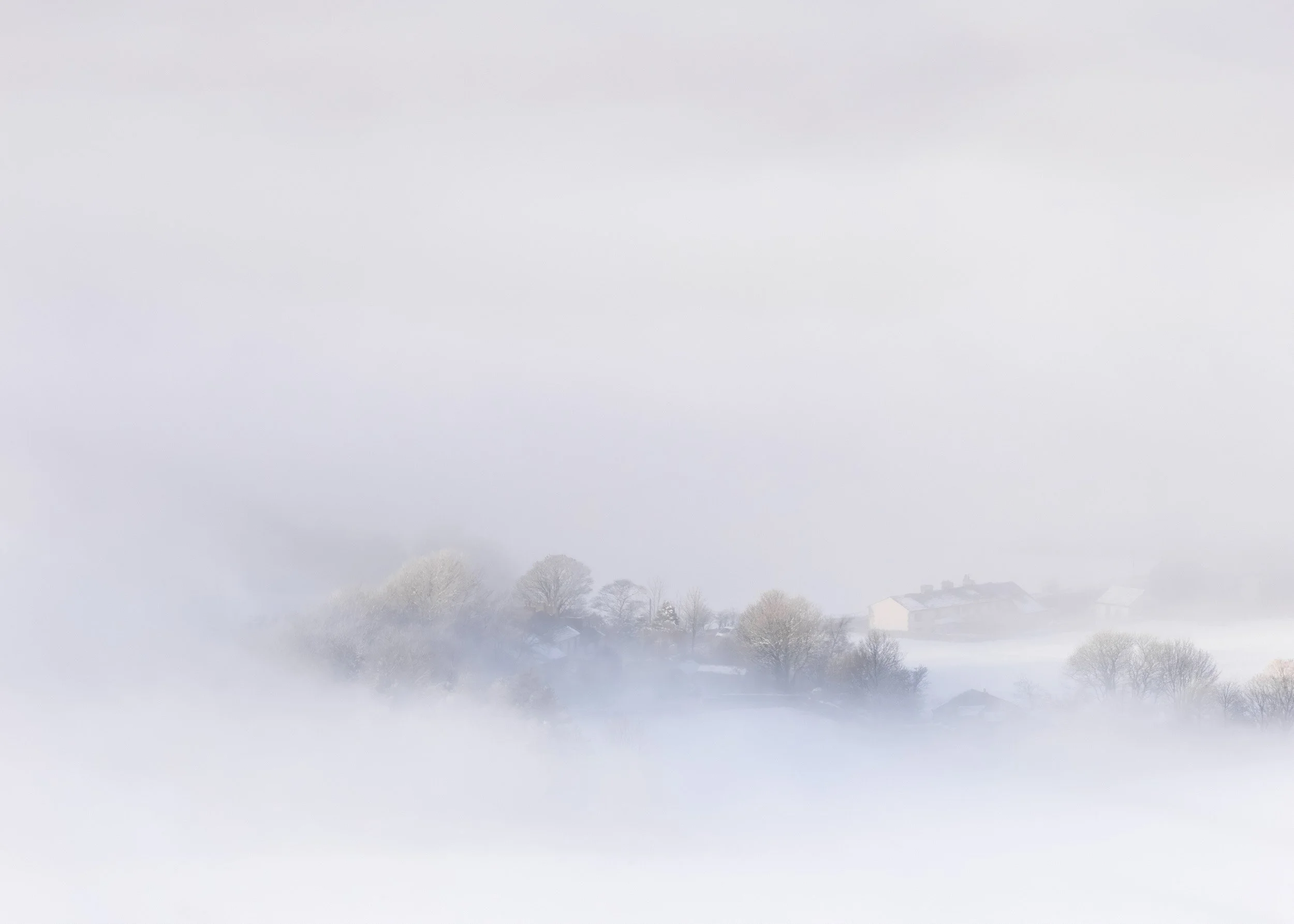
The South Pennines offer a landscape that feels powerful in these conditions. Open moorland, exposed ridges, reservoirs, and shifting weather create an environment in which change is impossible to ignore. One moment, distant hills are clearly visible; the next, rain and low cloud can soften the view.
There’s no promise of comfort in the landscape. There’s simply something happening, and I can direct my attention towards it.
How Landscape Photography Gives Difficult Emotions a Practical Outlet
Going outdoors is one thing. Taking a camera with me changes the entire experience.
Landscape photography provides a series of small, practical decisions. Where’s the light falling? What’s the wind doing to the grasses? Is the water moving in a way I want to convey? Which elements belong in the frame, and which elements are distracting?
These questions give my attention a task.
Instead of trying to solve every thought in my head, I can concentrate on one thing at a time. I might watch a patch of cotton grass bending in the wind, wait for a change in the light, or adjust my composition to bring a moving body of water into the frame to balance the surrounding landscape.
The weather becomes something I observe and work with rather than something I simply endure.
Photographing a storm also creates an interesting relationship between the world outside and the feelings inside me. When my thoughts feel unsettled, there’s something reassuring about a landscape that’s equally restless. The photograph can hold movement, tension, and uncertainty without requiring me to explain anything.
I can make an image of a turbulent reservoir or wind-swept moorland without pretending the scene is peaceful. Sometimes the photograph gains its power precisely because it reveals the conditions during which the photographer captured it.
And there’s a further benefit: I have something to look at afterwards.
The photograph becomes a record of when I went outside, engaged with nature, and took control on my own terms. It doesn’t need to be technically perfect to have value.
That’s one reason landscape photography for mental health has become part of my emotional maintenance routine. The reward is not just in the final image; it’s also in the process of making it.
How to Use Outdoor Photography for Mental Health When Overwhelmed
You don’t need expensive equipment, a dramatic location, or extreme weather to explore the relationship between photography and wellbeing. The aim is to find a manageable activity that engages your attention and gives you room to experience what you are feeling.
Here are a few practical approaches that may be worth exploring:
1. Choose an experience that suits your state of mind
Consider what you can manage on that day. If you feel restless and full of energy, walking a familiar route and photographing moving grasses, water, or trees may give you something constructive to concentrate on. If you feel exhausted or overstimulated, a sheltered spot beside a river or a short walk through a nearby park might be more appropriate. Let the conditions suit you, rather than forcing yourself to meet the demands of the weather.
2. Give your attention one photographic task
When thoughts become repetitive, a large or complicated activity is often difficult to manage. It may help to reduce photography to one simple objective. For example, spend a few minutes observing how wind changes the shape of a patch of grass, look for the way flowing water moves around a stone, or notice how rain changes the colour and texture of a path. Concentrate on one element rather than trying to create a finished photograph straight away.
3. Engage your senses
Photography naturally encourages observation, but the experience does not have to be entirely visual. Notice the sound of rain hitting your waterproof coat, the smell of wet earth, the temperature of the air against your face, or the texture of the ground beneath your boots. Some people, including neurodivergent individuals, find certain outdoor sensations uncomfortable or overwhelming. If wind, rain, noise, or cold increases your distress, reduce the intensity or choose another setting.
4. Experiment with movement in your photographs
A photograph doesn’t always need to freeze a landscape into perfect sharpness. Try photographing vegetation moving in the wind or capturing the changing surface of moving water. Allowing some movement into the exposure can communicate something you are experiencing or feeling. Experimentation itself can provide a useful focus.
5. Give yourself permission to stop
It’s easy for photography to become another activity in which you judge yourself by results. Try separating the value of the experience from the quality of the finished photograph. You may come home without an image, but you still spent valuable time outdoors. The experience does not have to justify itself through the final image.
Photographing Chaos: Using Shutter Speed in Storm Photography
There’s a practical photographic reason wild weather excites me: it offers movement that can become part of the composition.
When photographing wind-blown cotton grass, churning reservoir water, or vegetation moving across a moorland, shutter speed influences how that movement appears in the finished photograph.
A fast shutter speed can freeze movement, preserving the shape of individual grasses or the detail of water droplets. A slower shutter speed allows movement to register as blur, creating an impression of energy and change. Neither approach is automatically better; the choice depends on what you want the image to communicate.
When to freeze the movement
Using a faster shutter speed is helpful when your goal is to capture moving subjects clearly and preserve the details with no motion blur, and strong wind can often make life difficult for photographers. When aiming to freeze motion and reveal the detail of any moving object within the frame, for example, the falling rain illustrated below, start by using a faster shutter speed and review the image back in camera. Adjustments to your ISO or aperture may be required to attain a suitable exposure.
When to embrace the blur
A slower shutter speed can turn moving ojects into streaks and soften the image. for example, the movement of water illustrated below. This can produce an image that feels less like a static record of a scene and more like an interpretation of what it was like to stand there.
For a practical starting point, experiment with different shutter speeds and compare the results. A modestly slower exposure may introduce movement without losing the overall shape of the subject, while longer exposures create more pronounced blur.
Keep in mind that strong wind moves more than just the subject — it also affects your balance and camera stability. Experiment from a secure position, and consider using a tripod.
For me, this camera technique offers a practical way of making an image that reflects the character of a storm. Rather than fighting every movement to produce a sharp photograph, I can decide which movement belongs in the frame.
Storm Photography Safety: Respecting Wild Weather
There’s an important distinction between finding an outdoor experience emotionally engaging and deliberately exposing yourself to dangerous conditions.
The South Pennines can be challenging in strong winds, heavy rain, snow, and poor visibility. Weather on high ground differs significantly from conditions in a nearby town or valley, and it can change rapidly.
Before heading out, check the forecast for the specific area, pay attention to weather warnings, and choose a route appropriate to your experience and the conditions.
The Met Office mountain safety guidance provides practical advice on preparation and changing conditions.
My approach to storm photography safety always includes the following:
Choose your position carefully: Avoid exposed edges, steep ground, flood-prone areas, and places where powerful gusts could knock you off balance.
Protect your equipment: Rain covers, suitable bags, and a secure way to carry your gear help protect it, but equipment should never take priority over your safety.
Plan a retreat: Know how you’ll return to shelter and be prepared to abandon the photograph when conditions deteriorate.
Tell someone your plans: If heading into remote areas, let somebody know your intended route and expected return time.
There will be days when the responsible decision is to stay away from the moors or high ground. That doesn’t mean you’ve failed to find an outlet for difficult emotions—it means you’ve made a sensible decision about your safety. The landscape will still be there when conditions improve.
AuDHD, Nature Therapy, and Finding Your Own Way to Regulate
Receiving an AuDHD diagnosis gave me a different way to understand parts of my life. It helped me reconsider experiences that previously felt difficult to explain.
Photography and nature therapy have since become important parts of how I look after myself. However, I wouldn’t claim that the same approach works for everyone with autism, ADHD, anxiety, or depression. Neurodivergent people have different sensory preferences, energy levels, and support needs. Some may find a windswept moor invigorating; others may find the noise, unpredictability, and physical sensations exhausting.
Research provides encouraging evidence for nature-based activities, showing improvements in mood, anxiety, and stress levels following outdoor nature and photography activities. However, these findings do not establish that storm photography is a universal cure or that photography can replace appropriate mental health support.
What they do support is the value of exploring how contact with nature and creative activity might fit into an individual’s wider approach to wellbeing.
A systematic review of outdoor nature-based interventions revealed that there is evidence supporting improvements in depressive mood, anxiety, and emotional wellbeing.
Another study focusing on landscape photography and mental stress found that participants showed more relaxed reactions after taking part in a short nature-photography activity compared to an urban-photography activity.
Mindful Photography: What If a Storm Is Not What You Need?
The idea of standing in strong wind and driving rain may sound exhausting rather than restorative. You may have little energy, feel overstimulated, or simply not want to go outside.
There’s no need to force the experience.
You could try mindful photography close to home—photograph rain on a window, find patterns in your garden, explore a familiar park, or spend a few minutes observing a tree moving in a gentle breeze. If taking photographs feels like too much effort, leave the camera at home and take a short walk instead.
You can also approach nature photography without leaving home. Looking through previous photographs, editing a landscape image, or writing about a memorable place or experience can provide a meaningful connection to the outdoors.
If you notice that being outside increases your distress, choose a quieter environment or return to somewhere you feel safe. The aim is not to find the most intense experience possible; it’s finding an activity that offers a manageable way to engage with the world while dealing with difficult emotions.
And when even that feels beyond reach, it’s enough to recognise and admit that you’re struggling. You don’t have to turn every tough day into a productive exercise.
Mental Health Recovery: Learning to Move Through the Storm
I used to believe that peace existed only in stillness, without noise, pressure, or challenging feelings.
The South Pennines have helped me see that calm does not always arrive through quiet surroundings. Often, I find it while the wind is roaring across the moor, and rain or snow is sweeping through the landscape.
The storm outside does not resolve everything that’s happening inside me. It doesn’t erase my history or guarantee that tomorrow will be easier. What it gives me is an opportunity to engage with the present, to concentrate on something real, and to make a photograph that holds a little of what the moment felt like.
For me, that is part of what resilience means. It’s not about proving that I can withstand anything, or standing in increasingly dangerous weather to see how much I can take. It is about recognising what I need, finding constructive ways to respond, and knowing when to step back.
Often, I still experience difficult emotions and days when life feels overwhelming. But I’ve found an outlet that allows me to meet some of those feelings differently.
Sometimes the photograph is sharp. Sometimes the wind leaves its mark on the frame. And sometimes the most important thing I bring home is not the image at all—it is the knowledge that I went out, found my footing, and came back home safe and sound.
Frequently Asked Questions
Can landscape photography help with mental health?
Landscape photography may support mental health and wellbeing by encouraging mindfulness, creative engagement, and time spent outdoors. Research on nature-based activities and nature photography is encouraging, though benefits vary between individuals. Photography should complement, rather than replace, appropriate professional mental health care.
Can photography help with anxiety and emotional overwhelm?
For some people, photography provides a practical grounding focus when thoughts and feelings become overwhelming. Looking for patterns, working with light, or concentrating on composition can offer a manageable activity. It’s worth experimenting with different approaches to discover what suits your needs.
Do I need stormy weather to benefit from outdoor photography?
No. Storms are personally meaningful in my experience, but they are not necessary for photography to support wellbeing. Woodlands, rivers, gardens, parks, and quieter weather all offer opportunities for observation and creative activity.
What camera settings work best for photographing moving subjects?
A faster shutter speed helps freeze movement, while a slower speed allows movement to appear as blur. The right setting depends on the wind, the speed of the subject, available light, and the effect you want to achieve. Experiment and review your results — there are no rights or wrongs.
Is it safe to photograph landscapes in strong winds?
Strong winds can make exposed terrain dangerous, affect balance, and make camera handling difficult. Check weather forecasts, follow weather warnings, and avoid exposed ridges or cliff edges in hazardous conditions. Never take unnecessary risks for a photograph.
What should I do if I am struggling with urges to self-harm?
You deserve support, and you do not have to manage those feelings alone.
The first point of contact should often be your GP.
GPs play a vital role in assessing the situation, and can refer you to services tailored to your specific needs.
In the UK, there are lots resources and services designed to offer mental health support, guidance, and practical help. Not just for those who are struggling, but family and friends as well. Many of the services, which I’ll list below, also offer support for suicide, suicidal thoughts, and general support if you need someone to talk to
National Support Organisations
CALM (Campaign Against Living Miserably) https://www.thecalmzone.net/ a mental health charity mainly focused on suicide prevention, but they also provide life-saving, and practical mental health support to anyone who needs it.
Shout https://giveusashout.org/ is a mental health support service that offers free text messaging around the clock, available 24 hours a day, 7 days a week.
Shout is the UK’s first and only free, confidential text messaging service for anyone who is struggling to cope. Their text number is 85258.
Young Minds https://www.youngminds.org.uk/ a service aimed at young people, offering 24/7 support. The charity runs a variety of initiatives for parents, and professionals as well.
Their core purpose is to provide timely, accessible mental health support and prevent young people's mental health from reaching a crisis point.
ChildLine https://www.ch ildline.org.uk/ a service primarily for children and young people, under the age of 19 in the UK. You can call them on 0800 1111 to talk about any problem, whether it’s something big or something small. ChildLine is free, confidential and available any time, day or night.
The Silver Line https://www.thesilverline.org.uk/ offers friendship, conversation, and support to older people in the UK aged 55 and over.
Whether you’d like to exchange a quick “good morning” with someone, fancy a chat about how your day has gone, or need a trusted listening ear to share your thoughts and feelings with, they are there to talk. You can call them on 0800 4708090 24 hours a day, 7 days a week.
Specialised Self-Harm Support Services
Harmless https://harmless.org.uk/our-services/people-that-self-harm/ offers a variety of services related to self-harm, including support, information, training, and consultancy, aimed at people who self-harm, as well as their friends, families, and professionals.
They offer a variety of specialised therapeutic treatments aimed at helping individuals. Included in this are people who self-harm, along with their friends, their families, and the professionals involved in their care.
The support provided can take place through face-to-face meetings, video calls, or telephone sessions. Ensuring that the right support is provided to everyone. You can make a referral into the service by clicking here.
Battle Scars https://www.battle-scars-self-harm.org.uk/ are a small, dedicated, 100% survivor-led and run charity offering local, regional, national and international support around self-harm.
Their aim is to break down this stigma, raise awareness and challenge harmful myths, and support anyone affected by self-harm - regardless of gender, age, background or location. You can access there services by clicking here
Landscape, mind, or story—what brings you here?
Whether you’re a fellow photographer using the camera to process the noise, someone who relates to the highs and lows in this post, or you simply found a sense of calm in these words, I’d love to hear from you. You don’t have to carry it all quietly — feel free to drop me a message and share your own story.
When depression and anxiety become overwhelming, I turn to the wild weather of the South Pennines and the grounding experience of landscape photography. Through my journey with AuDHD and recovery, I explore how photographing storms, moving water and windswept moorland has helped me find a different way to navigate difficult emotions.