
Still Frames of Time
I stood on the edge of the moor for a long time, my camera still in its bag, wondering if waiting would ever be worth it.
The light wouldn’t settle into anything I could hold on to.
It thinned the hills, flattened the reservoir, drained the colour until everything hovered in the same dull register.
The wind kept starting and stopping, tugging at my jacket and biting my face, dropping away, then coming back again — just enough to keep my attention from landing anywhere.
I shifted my weight, fingers worrying the zip of my camera bag.
None of it was overwhelming on its own — the wind in my ears, the cold creeping up through my boots, the ache in my calves — but together it felt like too much to organise.
I should leave, I thought — I’d walked all this way only to confirm something I already suspected: that I didn’t have whatever it is people mean by patience.
I bargained with myself for five more minutes, which almost always turns into an hour or more.
All my life, patience and focus have been things I’ve lacked — or so it seemed.
I learned to push against that early on. Through work, hobbies, even creativity, I tried to force myself into steadier habits, longer attention spans, and better discipline.
Sometimes it worked briefly. More often than not, the effort itself became exhausting.
The harder I tried to hold my focus in place, the more it scattered.
What unsettled me most was the inconsistency.
I could concentrate deeply on the wrong thing, at the wrong time, while struggling with tasks that appeared simple to everyone else.
Noise piled on noise. Minor interruptions derailed entire days.
For a long time, I assumed this was a personal failing — a lack of patience, a flaw I hadn’t yet learned how to correct.
I kept searching for strategies, systems, and ways to improve myself into something more reliable.
Attention, Overload, and Misunderstood Focus
Understanding came slowly, and not all at once.
It took years of questioning, of noticing patterns I couldn’t explain, of recognising how certain environments drained me while others brought an unexpected sense of relief.
When doctors eventually gave that experience a name — Level 1 autism and ADHD, often described as AuDHD — it didn’t arrive as a revelation so much as a recognition.
The restlessness, the overwhelm, the constant sense of being slightly out of sync with the world around me weren’t new.
What was new was having language for them, and the permission to stop treating them as personal failures.
By then, I was already paying closer attention to how easily I became overwhelmed, how often my energy collapsed under ordinary demands.
I’d noticed patterns — the way certain environments drained me faster than others, how effort and pressure rarely produced the calm or focus they promised.
In 2025, I completed an A-Level in Understanding Mental Health.
I didn’t take it with an obvious outcome in mind; I was curious and tired of guessing.
I wanted language for things I could feel but couldn’t yet place — or, failing that, better questions to sit with.
The course resolved nothing in the way I’d quietly hoped.
What it offered instead was structure: frameworks, terms, ways of naming experiences that had previously felt shapeless.
Burnout, overload, regulation — words that didn’t solve the problem, but stopped it from feeling entirely personal.
I began to see why everyday things felt harder for me than they seemed to for others, and why I kept burning out on things I cared about.
The knowledge helped me recognise patterns I’d been living inside for years.
What the course gave me was language.
What it didn’t give me was peace.
That came from somewhere unexpected.
Photography as a Practice of Attention
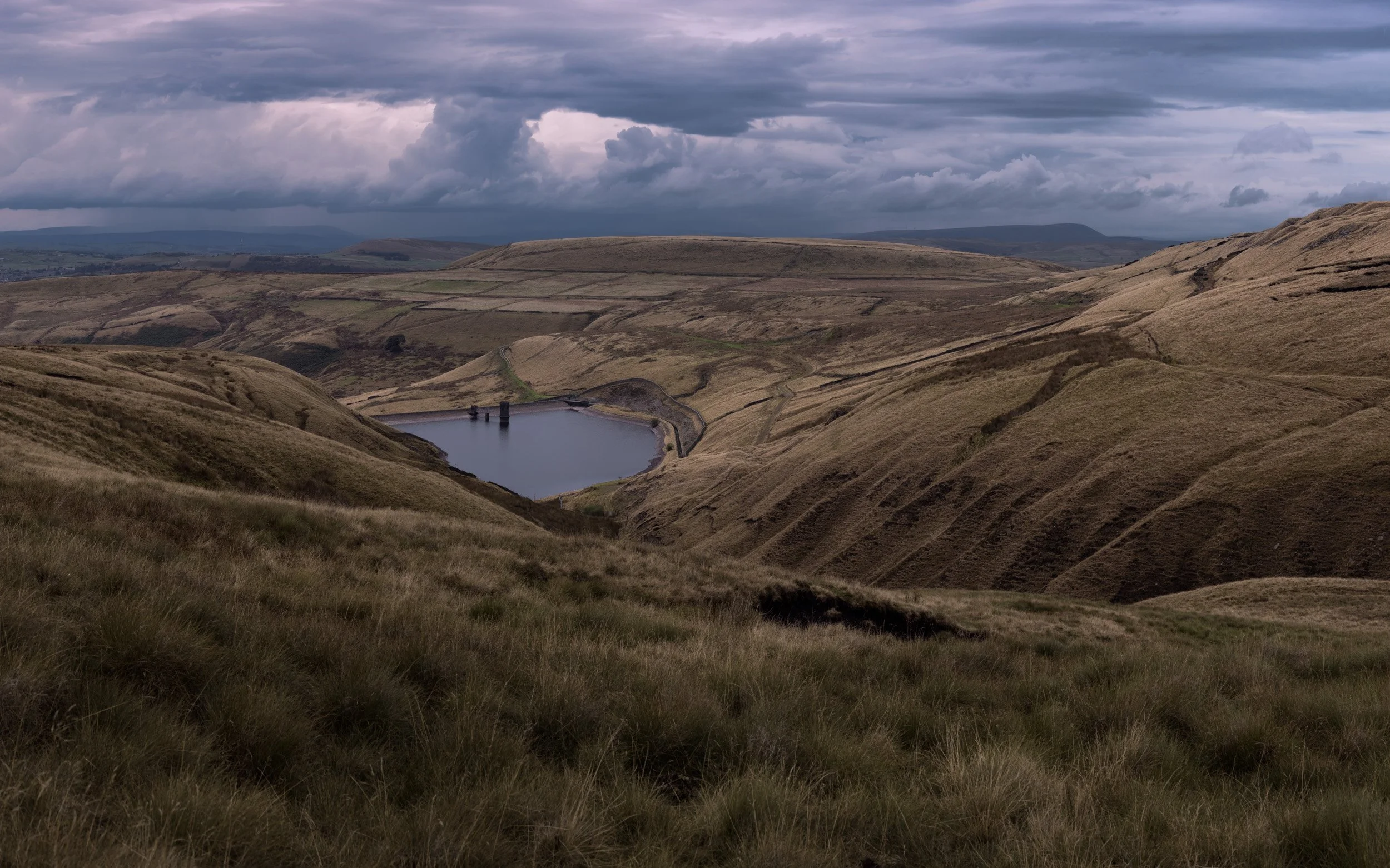
I photograph moorland in the southern Pennines — landscapes that don’t settle into a picture quickly.
No peaks pull the eye, no clear focal points hold it; the ground is mostly brown and grey: dried grass, dark peat, and wet stone.
The wind is ever-present, not strong enough to dramatise anything, just constant.
Underfoot, the peat gives slightly, holding water and slowing every step.
Some people find these places unattractive; others simply find them difficult.
I find them honest.
Busy environments have always overwhelmed me — constant activity, commotion, noise overlaps, and movements all compete for attention.
My brain struggles to decide what matters and what doesn’t.
On the moors, none of that applies.
The space is wide enough that my thoughts don’t collide, and I can finally breathe.
But that quiet comes with its own challenges.
The moorland doesn’t reward impatience; you can’t rush it or demand something dramatic from it.
You have to walk, stop, doubt yourself, walk some more.
Often, nothing happens for hours, sometimes days — just the wind brushing across grass and clouds shifting overhead.
At first, that felt unbearable. Time seemed to demand something from me: evidence, progress, a reason to be there.
My attention kept slipping forward, scanning the ground for a moment that would justify the waiting.
I became irritated, convinced I was overlooking something obvious, that it was my fault for not seeing it quickly enough.
I’d stop, doubt myself, and move on again.
Slowly, almost against my will, I learned that staying put wasn’t a prelude to the work — it was the work itself.
Finding Stillness in Unloved Landscapes
Before photography, focus always felt like pressure, like something I was supposed to grip tightly and felt guilty for dropping.
On the moors, focus behaves differently. It drifts, settles, wanders off, and then returns.
Some days I spend more time looking than photographing; on others, I lift the camera repeatedly, only to lower it again.
That used to feel like failure; now it feels like listening.
Watching cloud shadows move across the grass.
Realising the photograph isn’t there yet.
Admitting that I might go home without anything to show for it.
When I do make an image, it doesn’t feel forced; it feels earned — not through effort, but through attention.
The camera gives my mind something steady to rest on without demanding urgency or perfection.
Repetition as a Way of Seeing
I’m repetitive in almost everything I do.
I return to the same places, walk the same paths, stop in the same spots, framing similar scenes repeatedly, sometimes wondering if I’m doing something wrong — if I should chase novelty instead of circling familiar ground.
For a long time, repetition felt like a flaw I needed to fix.
But repetition is how I learn.
Each return strips away expectations.
The obvious decisions are made early, leaving space for quieter ones.
The landscape barely changes, but I do.
My attention sharpens. I notice smaller shifts: a subtle change in light, a different line through the frame, a moment I would have rushed past before.
Repetition gives me safety, and within that safety, freedom.
It allows me to slow down without feeling lost.
To deepen rather than move on.
What once felt limiting now feels like a way of seeing more, not less.
Autism and ADHD are often treated as tidy labels — but for me, they explained enough to make sense of things.
They explained why busy environments drain me to the point of shutdown, why my attention struggles under pressure, why stillness feels like relief, not boredom.
They also helped me understand that the way I photograph isn’t a flaw to correct; it’s a reflection of how I move through the world.
Out on the moors, there’s no expectation to keep up, respond quickly, or make immediate sense of anything.
The pace is slow, sometimes frustratingly so.
But it’s consistent, predictable and kind.
There’s a quiet freedom in photographing places that aren’t considered beautiful.
There’s no pressure to impress. No competition with iconic viewpoints. No sense that you’re doing it wrong if the image is subdued.
Instead, the question becomes: Why does this hold my attention?
That question matters more than any technical decision I make.
For individuals struggling with photography — especially if you’re neurodivergent — this can be a relief.
You don’t need to chase spectacle or work in ways that exhaust you.
You’re allowed to photograph what feels manageable, grounding, or simply tolerable on a difficult day.
Sometimes that’s enough.
When Landscape and Self Begin to Align
It took time, formal study, and diagnosis for the parallel to become obvious to me.
The landscapes I photograph are often dismissed as empty, uninspiring or misunderstood, judged on surface-level expectations.
So was I.
I spent years feeling the same way about myself.
The moorland isn’t empty — it’s subtle.
I wasn’t unfocused — I was overloaded.
The problem was never a lack of depth, but a lack of space.
Photography gave me that space long before I could explain why I needed it.
I still struggle and get distracted easily, and I still find some environments impossible to be in. I still return home with empty memory cards and a familiar sense of self-doubt.
But I’m learning to see those days as part of the process, not proof that I’m failing. The southern Pennine moorland continues to teach me how to slow down, how to notice, and how to accept subtlety — in the landscape and in myself.
I’m not patient by nature.
I’m not calm by default.
But out there, given enough time and space, I can be.
Scout Moor High Level Reservoir:
Still Frames of Time
For the last four years, I’ve returned to Scout Moor High Level Reservoir and the land that holds it.
What began as curiosity has become a quiet, ongoing conversation without words, with my camera acting as a modest interpreter of change.
I walk the same ground again and again. I watch the reservoir and surrounding moor shift under different light, in every kind of weather, across the seasons.
Clouds gather and break apart.
Wind moves across the open moor, reshaping the water’s surface.
Nothing dramatic happens, and yet nothing stays the same.
Making these images became a practice of attention.
I learned to recognise when the light was about to turn, to read the weight and movement of clouds, to feel how the wind alters the mood of the place long before it shows itself in the frame.
I came to know the land not as a subject, but as something familiar — shaped by repetition, patience, and time spent without expectation.
This work was never solely about taking photographs.
It was about being present long enough for something quieter to emerge.
Standing still.
Returning when there was nothing obvious to photograph.
Allowing the land to set the pace, rather than arriving with demands.
Each image carries the memory of a specific day — the conditions, the decisions, the moments of doubt or waiting that led to pressing the shutter.
Over time, those memories have become inseparable from the place itself.
Scout Moor is no longer a single landscape, but a collection of moments frozen in time.
These photographs are records of fleeting moments — repeated walks, many days and nights spent on the moor.
They map minor changes that are easy to miss unless you slow down enough to notice them.
They are an invitation to pause, to look closely, and to value what often goes unseen because it doesn’t ask for attention.
Out on the moor, each step has its own rhythm.
Wind, ground, movement, stillness.
A quiet cadence that lingers — not demanding to be heard,
only waiting for someone willing to stay.
Some places ask nothing of us,
and in that silence, give us everything.
The poem that follows belongs to the same practice:
shaped by weather, by walking, by waiting,
by leaving and returning,
until attention settles
and the ground begins to speak.
For years I walked the moor in quiet return,
Drawn not by haste, but a need to discern
What changed, what stayed, what learned how to stay —
The land would speak if I waited each day.
I came with a camera, humble and small,
No louder than wind through the wire fence wall.
It wasn’t a weapon to capture or claim,
Just a witness to weather, to loss, and refrain.
The reservoir lay like a held-back thought,
Sometimes full-bellied, sometimes near naught.
It mirrored the sky in fractured reply,
A question of water asking the sky why.
Clouds rehearsed dramas the light would revise,
Grey into silver, then sudden surprise.
I learned their timing, their subtle deceit,
How brilliance arrives on reluctant feet.
Spring never rushed here; it tested the ground,
Green learning courage where brown had been found.
Shoots pressed upward, unsure if they’d stay,
While frost still remembered the grip of its say.
Summer arrived like a breath briefly held,
Warmth touching peat like a promise half-spelled.
Light lingered longer, yet never too long,
As if it knew better than faith or than song.
Autumn rewrote the land in gentle retreat,
Bronze pooling low around water and peat.
Each step sounded softer; the wind learned restraint,
As if even decay had learned to be faint.
Winter returned with a practiced hand,
Erasing the footnotes of grass and of land.
Ice stitched the surface in delicate lines,
Time learning stillness, then fracturing signs.
And I returned — again and again —
Through sideways snow and horizonless rain.
Each visit, a sentence the land would extend,
Each leaving a comma, not closure or end.
I learned how the wind sculpts emptiness whole,
How silence can weather the shape of the soul.
The moor did not teach me by speaking aloud,
But by what it withheld, by what stayed unbowed.
Some days were nothing — no miracle staged,
Just light being light, untroubled, unaged.
Yet later those days would return in the mind,
As proof that the ordinary once felt kind.
Other days burned with a brief, borrowed fire,
A flare in the clouds, a gold-threaded wire.
I knew not to chase it — it asked to be still,
To be held in the eye, not bent to the will.
Each image I made was a narrowing gate,
A pause in the onward insistence of fate.
A fraction of breath, a held-open door,
Between what was leaving and what came before.
Within them live moments I cannot replay:
Icy fingers, wet boots, thoughts drifting astray.
They hold what I carried, the weight of the hour,
The quiet endurance of standing with power.
Four years passed softly, disguised as return,
The same path repeating, yet asking to learn.
The land aged beside me, or maybe stood still,
While I learned the patience of watching the hill.
Now light lingers briefly, then drifts from its stage,
The moor draws a slow breath, marking year upon age.
Four years hang suspended, in memory and rhyme,
Silent witnesses held in still frames of time.
So seize the day softly, in each glance and pause,
In learning the language of wind, water, and cause.
The fleeting, the ordinary, the overlooked way
Becomes luminous when we simply stay.
This work does not shout, nor demand to be known,
Its voice lives in quiet, in patience alone.
In watching, in waiting, in seeing again,
We touch what persists beyond measure or end.